The Architect's Eye: What Konark Still Teaches, 700 Years Later
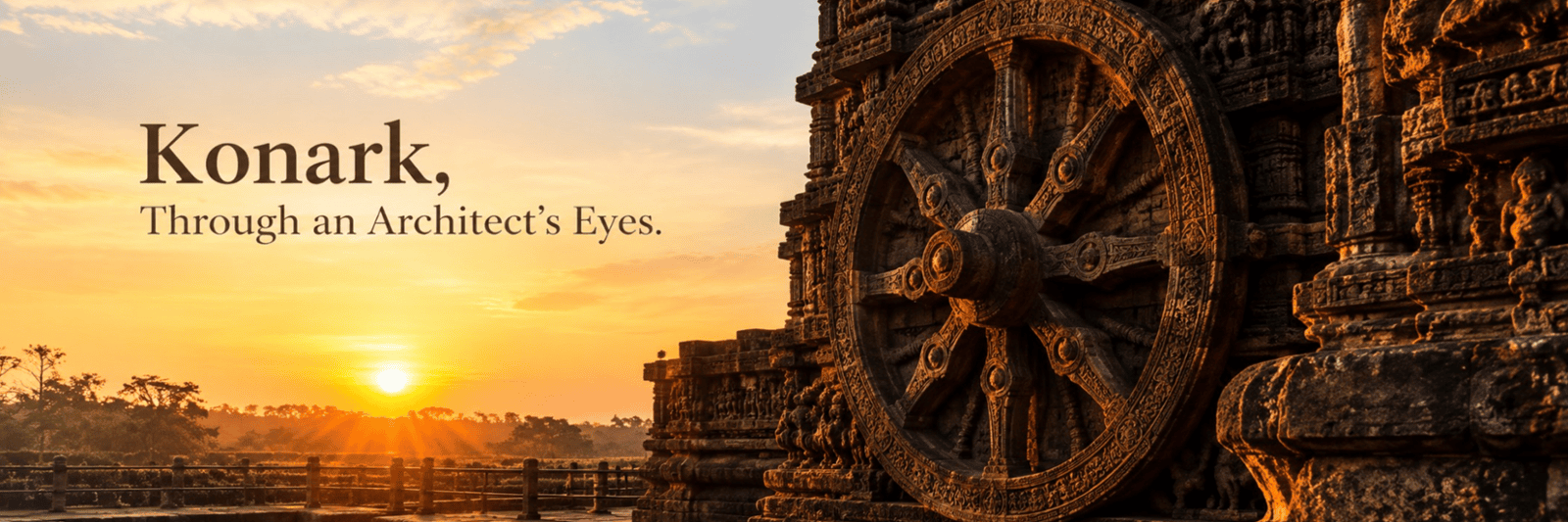
The Sun is a God for as long as it has been there. To some, it brings harvest; to some, it shines and saves them from cold winters. The Sun is the only thing that exists beyond humanity. And all living creatures can testify that the sun does not usually wait for anyone. It waited for a boy on a beach for twelve years.
The books and folklore say Samba, one of Krishna's sons, came to that shore carrying a curse under his skin and nothing else. No priest beside him, no prayers said over him, just the steady tide pulling in every evening and the same ever-living Sun climbing back every morning to find him still there. Twelve years he sat facing it, until one morning the soft sunlight didn't just rise, it reached him. Whether this was out of compassion or admiration, only the Sun's rays know. Samba's skin cleared, like something remembering what it used to be. Twelve years of fortitude, a faith like a lighthouse, and in the end, the Sun's blessing. Before he left that shore, he built a small shrine and placed in it an image of the sun god, the very gift Surya had left behind as proof the healing was real.
That humble shrine kept the memory alive long after Samba was gone. Mothers told their sons about the coast where the sun once bent low enough to cure a curse, and years later a queen, Kasturi Devi, knelt on that same shore and asked the sun for a son of her own. When Narasimha Deva was born, she never called it luck. She called it a debt.
So years later, when her son came home from war with hard-won victory still fresh on him, she didn't ask what he'd won. She told him what he owed. His father had already given the world the Jagannath Temple at Puri. She wanted her son to give it something no one had ever seen, stone that could hold sunlight the way that shore once had, a chariot vast enough to carry the sun itself across the sky and never let it leave again.
That's the wish twelve hundred tireless hands would spend the next twelve years trying to keep.
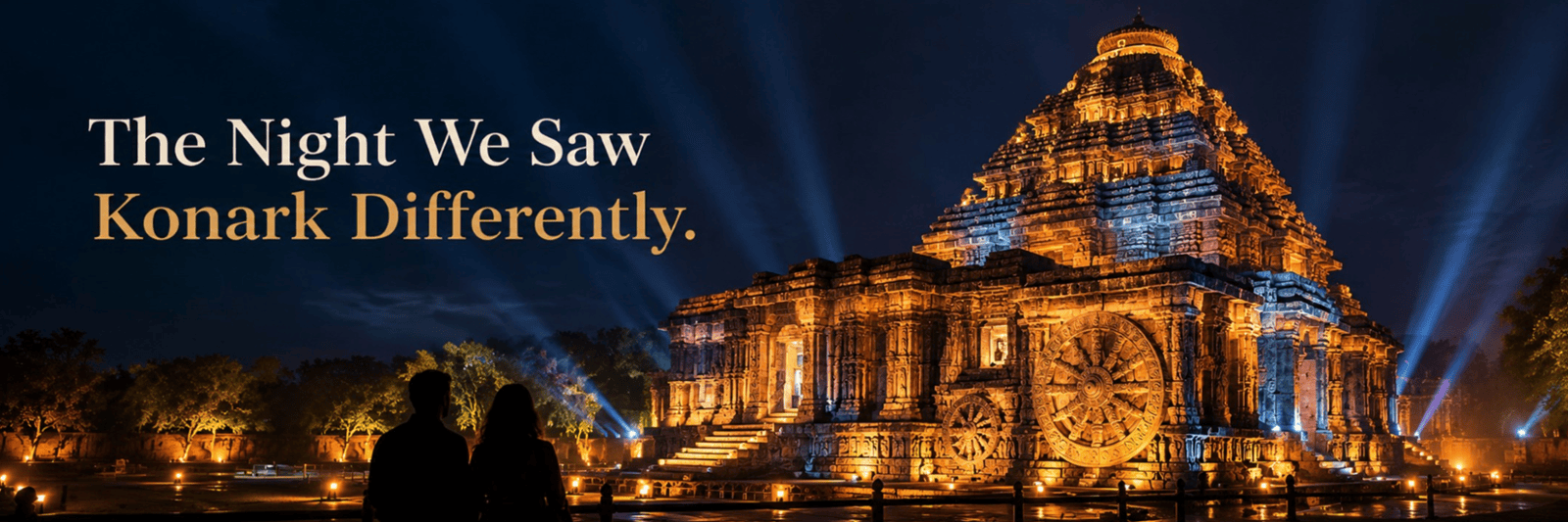
That wish did not stay buried in an old story. Centuries later, in 2026, two people stood on that same ground at night and felt it reach them too.
The team TCA had gone to Konark like most people do, to see the temple standing quiet in the daylight. But it was the night that stayed with them. As the light and sound show began, the temple lit up against the dark, a stone ember the night had kept warm for centuries, and a voice recounted the story of Samba: the boy, the mother's wish, the king who carried it out. And as they listened, what held them most wasn't the king or the gods. It was the architects. People who had no machines, no shortcuts, nothing but stone, patience, and a plan held entirely in their own hands, and yet they built something the world still travels to see, centuries later.
They came back from that trip thinking about those architects often. Not as a story to retell, but as a standard to live up to. That respect, for what it truly takes to design something built to last, is what The Construction Avenue carries into every project it takes on today.
Some of what Konark's architects attempted sounds less like construction and more like physics nobody had a name for yet. Legend holds that a lodestone weighing close to 53 tonnes was built into the crown of the temple, strong enough to hold the structure's iron framework together without mortar. A smaller magnet is said to have been placed at the base of the sanctum, positioned so precisely that the idol of the Sun God appeared to hover in mid-air, suspended between the pull of the two stones. Sailors passing the coast reportedly steered clear of it, their ship compasses spinning uselessly near the shore. Historians today can't confirm that the magnets ever existed, as the stone that held them is long gone. Yet the fact that this idea has survived 700 years says something about how impossible the engineering must have looked to the people who saw it.
Confirmed or not, the physical remains leave little room for doubt about the scale involved. The temple was raised to nearly 230 feet at its tallest, built from over 10,000 tonnes of stone, carved and placed without a single crane, pulley system, or modern surveying tool. Every piece had to be measured, moved, and fitted by hand, and it had to survive salt air, shifting sand, and a coastline that never stays still. Whether or not magnets ever held it together, something clearly did, precisely enough that we are still trying to understand it.
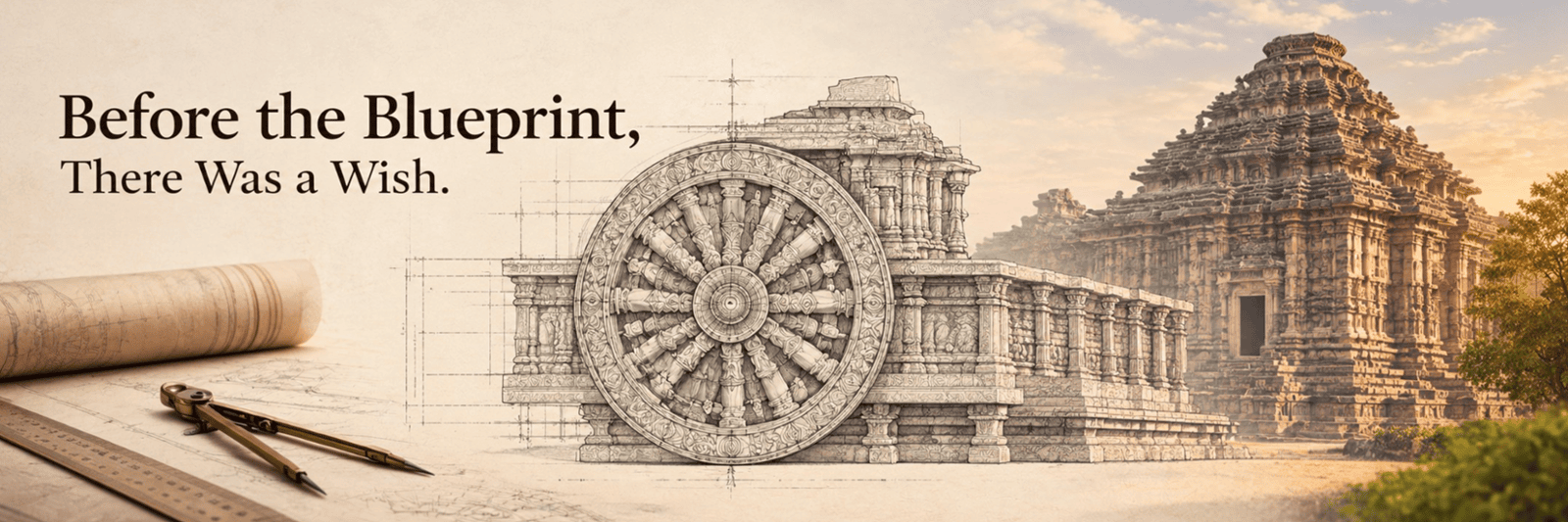
Whatever truth lies behind the magnets, what's certain is standing right there in stone, still being measured and studied 700 years later. That's the part The Construction Avenue pays attention to. The site pushed back with tide, salt, and shifting sand, and the architects never rushed past that resistance. They examined it until the land itself told them how to build. That same patience shapes how TCA approaches a site today, understanding the ground before deciding anything on top of it. Speed was never the goal at Konark, permanence was, and it's the same measure TCA builds toward, work meant to hold its shape decades after the scaffolding comes down.
Every site carries its own version of that resistance, and the first job is to read it. As a construction company that takes on residential construction, commercial construction, and turnkey construction, The Construction Avenue starts by listening to the land and builds what lasts.